

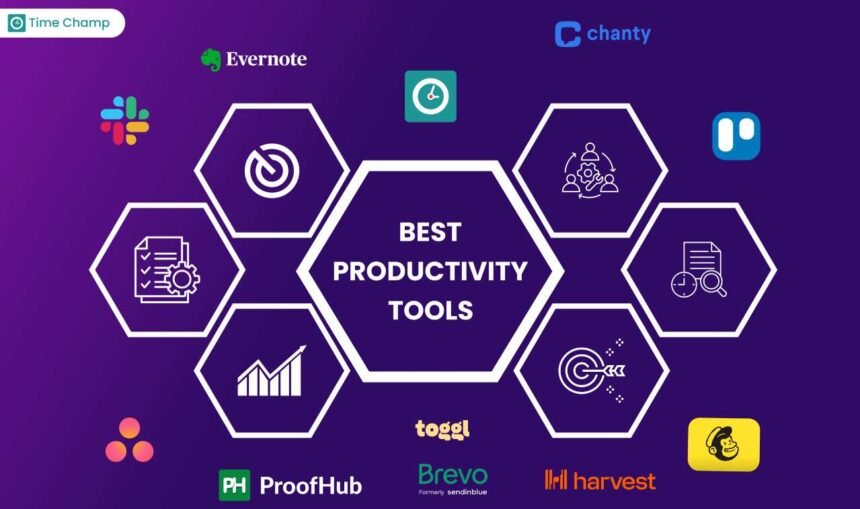
Introduction to Productivity Tools
In the modern-day world of hectic schedules, it is difficult to keep productive. There is no end to distractions. Deadlines loom large. However, the right labor tools can change the way you work. They enable you to be focused, organized, and efficient.
Productivity tools can save time and eliminate stress, whether you are on the other hand a freelancer, a student,or a busy person. This paper presents the most effective productivity tools to optimize your work and improve productivity effortlessly.
What Are Productivity Tools?

Productivity tools refer to software or applications that enhance efficiency. They assist you in organizing duties, time management, teamwork working and doing automated work. These are tools that make a complex process easier.
They allow you to live in what is important. From task managers all the way to note-taking apps, there are plenty of productivity tools. They are designed to streamline your work process and to make it more efficient.
Why Use Productivity Tools?
Productivity tools are time-saving tools. They reduce manual work. They assist you in being on schedule. In their absence, you could probably have several tasks in your head. This causes stress and error. Applications such as to-do list programs or calendar programs have all that in one place. They also enhance teamwork. All you need is the proper tools, and you can work hard, not smart.
Best Productivity Tools to Change Your Workflow
The number of productivity tools is endless. Each serves a unique purpose. Some of the most effective tools to improve your everyday working process are discussed below. These are user-friendly, versatile, and highly effective tools.
Task Management Tools
Task management applications assist you in managing and prioritizing tasks. They are ideal for breaking down the project into small steps.
Trello: Project board.
Trello is a program that operates on boards, lists, ts, and cards. It is preferable to visual learners. You are able to have a board per project. Include categories such as To Do, In Progress, and Done. Cards are tasks on a personal level. You are able to assign a due date, file attachment, as well as collaborate with other people.
The drag-and-drop feature of Trello is easy to use. It is excellent in individual and team projects. As an illustration, Trello can help a marketing team to monitor the progress of a campaign.
Todoist: All the Power and the To-Do.
Todoist is a minimal task manager. It is ideal to use forr generating to-do lists. You can establish priorities and deadlines, as well as recurring tasks. Todoist is cross-platform, and therefore, you can access your tasks anytime. It also works with applications such as Google Calendar. As an example, Todoist can help a student to keep track of the assignments and study timetables. It is easy to remain focused because of its clean design.
Time Management Tools
The best thing you possess is time. Time management software will assist you in putting it to good use.
Toggl Track: Easy Time Tracking.
Toggl Track measures the way you spend your hours. It works well with freelancers and teams. You are able to keep track of time wastage on activities or projects. The tool creates reports that are used to analyze productivity. As an illustration, a graphic designer will be able to monitor the number of hours devoted to a client’s work. Toggl has a simple interface where unusual to start and stop timers. It also combines with the usage of tools such as Trello and Asana.
RescueTime: Auto: Productivity Intelligence.
RescueTime is operated in the background. It monitors the duration of use of apps and sites. The tool identifies the activities as useful or distracting. You receive in-depth reporting of your habits. It may also indicate your time pent on social media, to give example. RescueTime assists you in finding out time-wasting behaviors and remain focused.
Note-Taking and Organization Tools
Good note-taking tools will keep your ideas straight. They are necessary in brainstorming and planning.
Notion: All-in-One Workspace
Notion is an all-purpose note, database, and project management tool. You can make wikis, calendars, or boards of tasks. The versatility of Notion is appropriate for students, professionals, and creators. To take an example, a writer may arrange research and drafts with the help of Notion. It has customizable templates that enable you to customize it tthemyour needs.
Evernote: Store Ideas everywhere.
Evernote is a traditional note-taking application. It allows you to write down ideas, pin web articles, and highlight documents. You are able to tag and categorize notes using notebooks. Evernote can be accessed on all platforms, sm hence the notes are always present. As an example, an entrepreneur will be able to store notes of meetings and receipts in a single location. Its search option even identifies text on images.
Collaboration Tools
Teams require collaboration tools. They provide proper communication and alignment of the project.
Slack: Slimmed Down Team Communication.
Slack is a team messaging application. It groups discussions into channels. You are able to share files, combine applications, and place voice calls. Slack reduces email clutter. There are also such examples as a remote team discussing projects with the help of Slack. Its connections to such tools as Trello and Google Drive improve efficiency.
Asana: Team Management.
Asana assists groups in handling projects and activities. You are able to assign tasks, introduce deadlines, and monitor progress. Asana has a list, board, and timeline display. It is perfect for complicated projects. An example of this is that an event planner can organize vendors and schedules with Asana. Its intuitive interface puts everyone at the same level.
Automation Tools
Repetitive tasks are done away with through automation. They are time-saving and they minimize errors.
Zapier: Connect Your Apps
Zapier is the automation of workflows through the use of apps. As an illustration, you can program a Zap, which would automatically save email attachments in Google Drive. Zapier integrates with thousands of apps, such as Gmail, Slack,ck, and Trello. Zapier can help a small business own to automate customer follow-ups. It is a game-changer among busy people.
IFTTT: Easy Automation for all.
IFTTT (If This, Then That) is a simple automation. Apps can be connected to accomplish tasks. As an instance, you may program IFTTT to automatically post your Instagram photos to X. It is easy to use and works with smart home gadgets as well. IFTTT is very useful in automation on a personal and professional level.
How to Choose the Right Productivity Tools
It can be hard to decide which tools are the right ones to pick, given all the options. Here’s how to choose wisely:
Identify Your Needs
Begin by evaluating your operations. Do you have problems with organizing tasks? Time tracking? Collaboration? List your pain points. As an illustration, when you are constantly failing to meet deadlines, a task manager such as Todoist will be a good place to begin. In case you spend time on distractions, use RescueTime.
Consider Ease of Use
Select tools that have a user-friendly interface. Complex instruments can retard you. Test free versions or trials. As an example, the drag-and-drop tool of Trello is user-friendly. Although strong, Notion does have a learning curve. Pick what feels comfortable.
Check Integrations
Applications that attach to your current applications save time. As an illustration, in case you utilize Google Calendar, you may connect with a tool like Todoist that is linked to Google Calendar. Integrations provide a smooth working process.
Evaluate Cost
A variety of productivity tools have free plans. Other features require subscriptions. Compare costs and features. As an example, the free version of Evernote is adequate to take notes, whereas the paid version has more storage. Budget wisely.
Advantages of Productivity Tools

There are many benefits of productivity tools. They conserve time through automation. They lower the stress level since they help you to stay organised. They enhance concentration by reducing distractions. Better communication and alignment are achieved in teams. As an illustration, a freelancer under Toggl Track is able to charge customers properly. With Notion, a student is able to keep up with assignments. Such tools render work easy.
Real-Life Examples
With Sarah, a project manager, in mind. She works with Trello to monitor the work of her team. Slack maintains clear communication. Zapier automates her reports. These tools reduced her working time to two hours. Or take John, a student. He works on Todoist on assignments and RescueTime to prevent distractions. His grades were much better. Everyone is productive with the use of productivity tools.
Productivity tool Maximization tips.
These are the tips to get the best out of these tools:
- Start Small: Do not go too big. Begin with one or two tools. Learn to cook, and then add to it.
- Establish Specific Objectives: Establish what you wish to accomplish. As an example, include Trello to split projects into action steps.
- Review Periodically: Review your progress every week. Distractors such as Toggl Track give you insights to optimize your habits.
- Be Consistent: Add your instruments every day. Stability forms routines and increases productivity.
- Browse Additions: Some tools contain some gems. As an example, templates in Notion can make complicated projects less complicated.
Conclusion
Game changers are productivity tools. They make your work smoother, save time, and reduce stress. Task managers such as Trello or automation tools such as Zapier are all there. Determine what you need, select tools that are euse to us,e and begin small. You can easily increase your productivity with the appropriate instruments. Get control of your workflow now. Use any of the,se and you will be flying.